2026
S28 Youth Cup: Espanyol and Sporting crowned champions
By David Marsden · Hamburger SV
The finals are done. Espanyol Academy (Glen Mullan) won the Youth Cup, and Sporting (Carl Martin) won the Youth Shield.
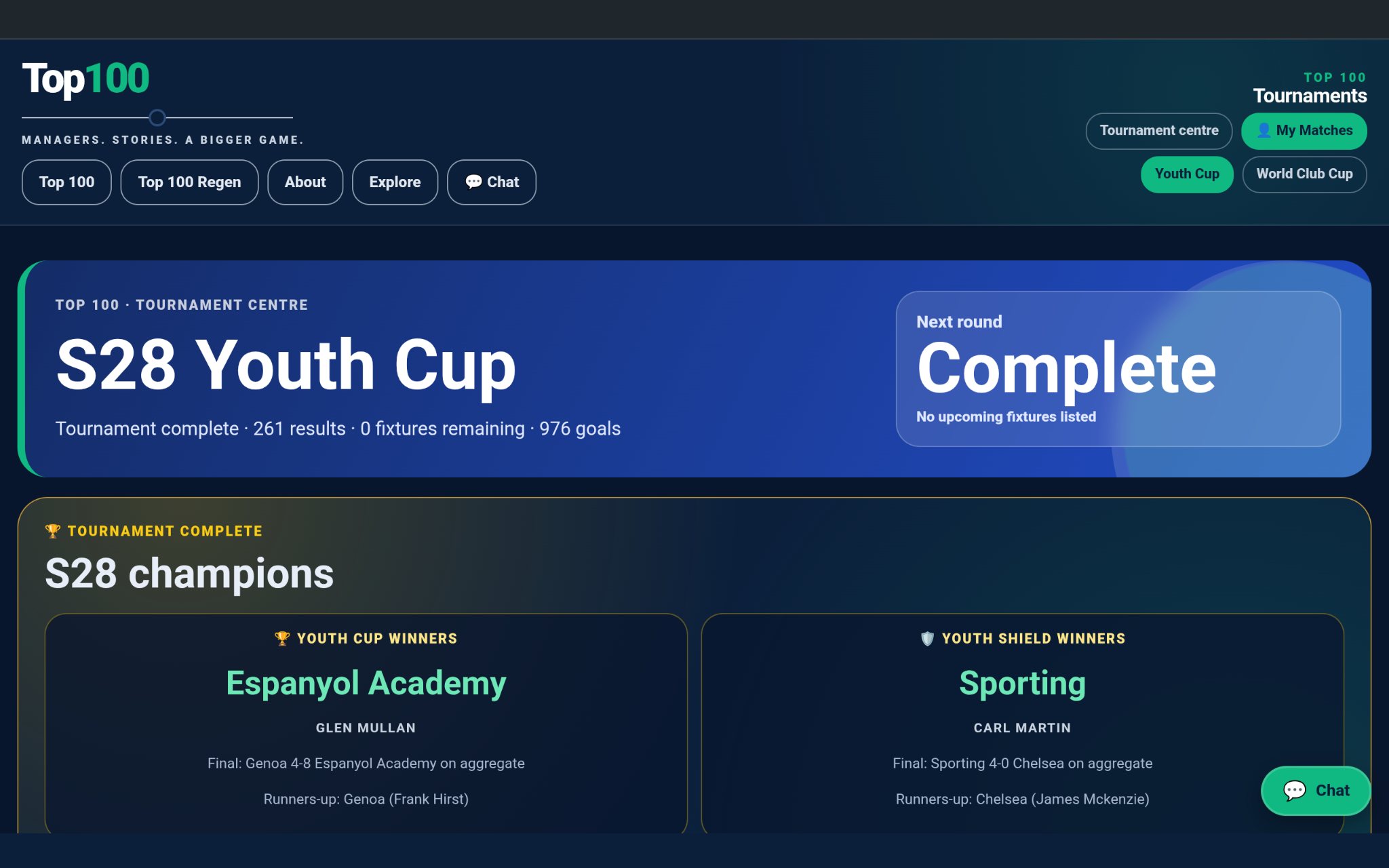
Both teams retained the trophies they won last season, and Espanyol completed a hattrick of wins.
Youth Cup Final
- Espanyol Academy swept past Genoa 8-4 on aggregate (Genoa 2-4 Espanyol Academy; Espanyol Academy 4-2 Genoa).
Youth Shield Final
- Sporting swept past Chelsea 4-0 on aggregate (Sporting 2-0 Chelsea; Chelsea 0-2 Sporting).
Espanyol Academy’s road to the Youth Cup title
- Round of 32: swept past Bremen 4-0.
- Round of 16: swept past Milan 9-1 on aggregate (Milan 1-4 Espanyol Academy; Espanyol Academy 5-0 Milan).
- Quarter-finals: swept past Leicester Youth 6-1 on aggregate (Espanyol Academy 2-1 Leicester Youth; Leicester Youth 0-4 Espanyol Academy).
- Semi-finals: edged Besiktas 3-3 on aggregate on away goals (Espanyol Academy 0-2 Besiktas; Besiktas 1-3 Espanyol Academy).
- Final: swept past Genoa 8-4 on aggregate (Genoa 2-4 Espanyol Academy; Espanyol Academy 4-2 Genoa).
Sporting’s road to the Youth Shield title
- Round of 32: swept past Dynamo Moscow 3-0.
- Round of 16: swept past FC AUGSBURG 5-2.
- Quarter-finals: beat Bremen 1-0 on aggregate (Sporting 0-0 Bremen; Bremen 0-1 Sporting).
- Semi-finals: beat Anderlecht 3-2 on aggregate (Anderlecht 1-2 Sporting; Sporting 1-1 Anderlecht).
- Final: swept past Chelsea 4-0 on aggregate (Sporting 2-0 Chelsea; Chelsea 0-2 Sporting).
From the press room
“Absolutely thrilled to make our 7th final in 9 seasons. Its a repeat of last seasons final and it promises to be a cracker. They’ve a free scoring awesome team, and we need to raise our levels if we are to come out on top over 2 legs. Endrick will go down in Espanyol history as both a star of the youth cup but also first team. The step up of 9 of our youth team to the first team in division 1 this season has been fairytale stuff. We are now two games away of a potential 3 in a row.”
— Glen Mullan, Espanyol, pre-match before Genoa v Espanyol Academy
That’s a wrap
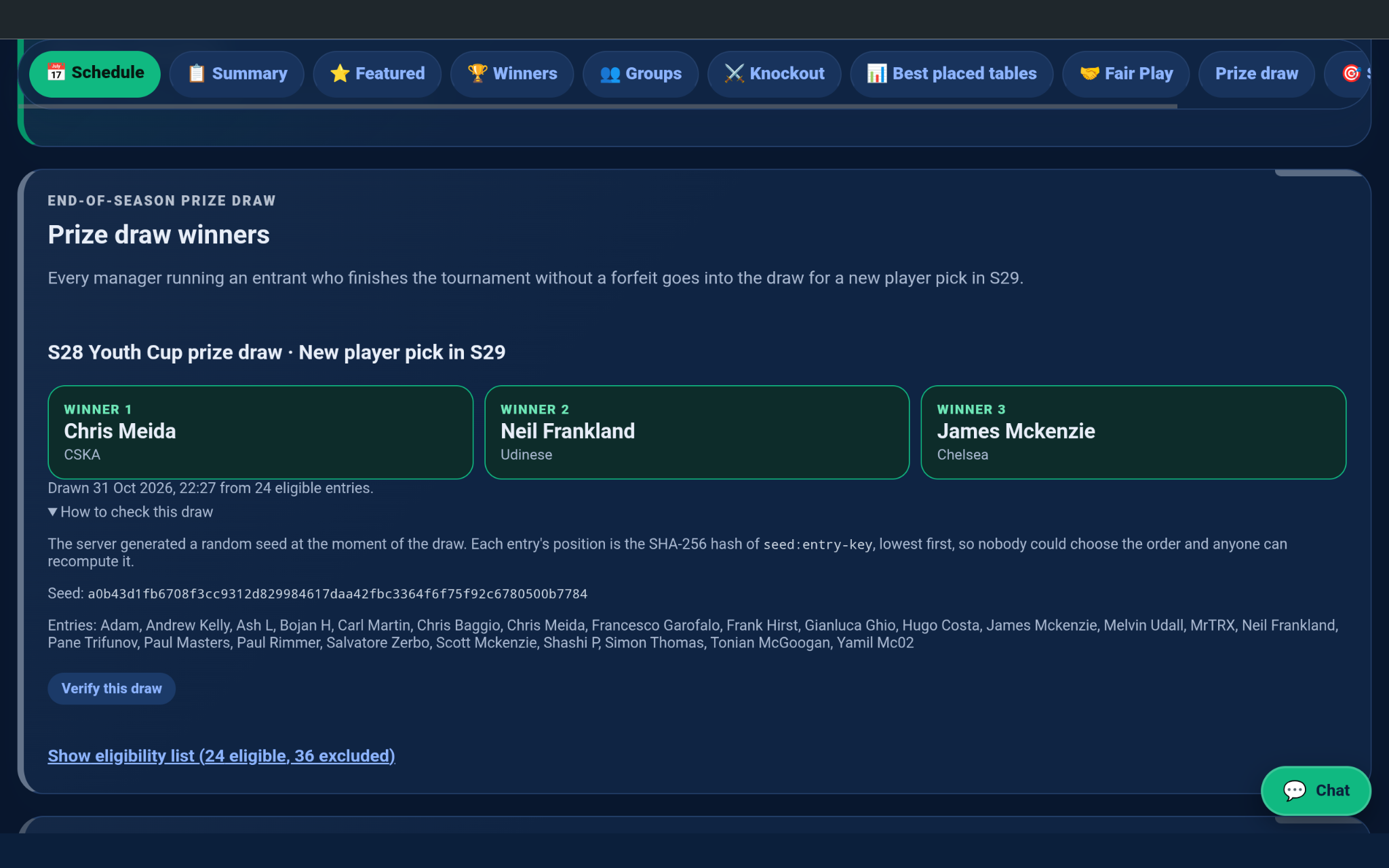
Thanks to every manager who took part. The S28 Youth Cup is now archived, and the end-of-season prize draw for managers with a clean fair-play record is completed.
Follow every tie, result and bracket on the Top 100 Tournament Hub
New Alerts for Manager Accounts
Top 100 has implemented regular updates and AI monitoring to ensure compliance with squad limits and manager activity, improving oversight and enforcement of their rules.
Apply to Manage a Vacant Club
A structured and transparent process is now in place for filling managerial vacancies at Top 100 clubs, involving published applications, scoring criteria, and public accountability for decisions.
S28 Sackings and Reappointments
The new rules for manager reappointments in the bottom three of Top 100 establish consistent decision-making based on specified criteria, ensuring that managers receive the benefit of the doubt unless clear errors occur.
SCHALKE 2-1 OLYMPIACOS | THE REVIVAL CONTINUES!
Schalke secured a dramatic win against Olympiacos with a late goal, showcasing the strong performances of five new signings in their continued turnaround.
THE FALL OF SCHALKE
Tom Lee takes on the challenging task of reviving Schalke 04, a club that has suffered four consecutive relegations and a turbulent managerial history, aiming for stability amidst uncertainty.
The New Top 100
4 short podcasts. After a Youth Shield fiasco, here’s what’s changing in Top 100 and why it should mean less admin, fairer tournaments and more fun for everyone.
Youth Cup fixture arrangements: rules clarification
By David Marsden · Hamburger SV
Yesterday’s Youth Shield round exposed two separate problems, and it is worth being clear about both of them.
First, the new Tournament Centre was harder for some managers to navigate than it should have been. I accept responsibility for that. Based on the feedback, the tournament site has already been changed to make the schedule much easier to find, and My Matches now gives managers a simple personalised view of who they are playing and whether they should send the friendly request or expect one.
Second, one part of the published Youth Cup rules had become out of date. The old wording told an away manager who had not received a friendly request to contact the home manager 24 hours before kick-off. That was written when Soccer Manager allowed friendlies to be arranged much later. Changes to the game now mean that Wednesday can be the last opportunity to arrange a Saturday friendly.
The rules have therefore been clarified for future rounds.
Fixtures will normally be published by Sunday evening. The home manager should send the Soccer Manager friendly request promptly and no later than Wednesday. The away manager must also check the fixture and, if no request has arrived, contact the home manager before Wednesday’s arranging window closes. If either manager encounters a problem, they should tell the organiser while there is still time to resolve it.
The responsibility remains shared, but that does not mean the two jobs are identical. The home manager initiates the fixture; the away manager checks that it has happened and chases if it has not. Where there is a dispute, evidence of a timely request, message or attempt to resolve the problem can distinguish the manager who made a reasonable effort from the manager who did not. If neither manager makes a reasonable effort, both can forfeit.
Tournament reminders and newsfeed posts are useful back-ups, but they do not replace managers’ responsibility to find their fixture and arrange it in time.
This clarification takes effect from 13 September 2026. It does not retrospectively reopen the S28 Youth Shield Round of 32 decisions from 12 September. Those decisions were made under the rules and circumstances applying to that round.
The change is recorded in the Top 100 rulebook and in the full Youth Cup rules rather than silently replacing the old position. That matters: when the platform changes, our procedures sometimes have to change with it, but we should always be able to establish which rule applied at the time.
The practical version for managers is very simple: check My Matches on Sunday, send or chase the request, and don’t leave it until the end of the week.
Top 100 has moved
The Top 100 website is transitioning from WordPress to Micro.blog, preserving its history while simplifying the contribution process for managers.
Regen Then & Now: Three Seasons Later
Updated after the completion of Season 3.
When Top 100 Regen launched, its hierarchy came from the real world.
The 100 clubs were allocated to five divisions using Opta rankings. Real Madrid began at the summit; clubs such as Maccabi Haifa and New England Revolution started deep in Division 5.
At the start of S3 we took our first proper look at how much that world had already changed.
Now Season 3 is complete — including the play-offs — we can go one step further.
The answer is: a lot.
By the numbers
At launch, the combined value of all 100 squads was approximately £12.71 billion.
By the end of S3 it was around £16.70 billion.
That’s an increase of almost £4 billion — roughly 31%.
The average squad rating has risen from 85.26 to 88.04.
Of the 100 clubs:
- ⭐ 73 have a higher average squad rating than at launch
- ➡️ 17 are unchanged
- ⬇️ Only 10 are rated lower
And once S3’s promotions and relegations are applied to the S4 line-up:
- 🔼 25 clubs will be above their original S1 division
- 🔽 29 will be below it
- ➡️ 46 remain in the same tier
More than half the Game World will therefore begin S4 somewhere other than the division in which Opta originally placed them.
One important caveat: the rules changed too
Not all of the increase in squad strength and value should be treated as pure manager-driven growth.
The Game World’s rules have evolved.
In S1 we operated a 30-player split squad cap:
- maximum 19 first-team players
- minimum 11 youth players
For S3 this was replaced by a simple 40-player overall squad cap.
That gives clubs considerably more freedom to retain senior players, prospects and transferable assets simultaneously. It naturally contributes to higher total squad values and, potentially, higher squad-average ratings.
The transfer rules changed too.
In S1 and S2, the maximum cash component of a transfer was £99 million.
For S3 we reduced that to £50 million.
That is why the S1 and S2 record-transfer lists contain walls of £99m deals while S3 contains numerous £50m transfers — often supplemented by players in exchange.
So the numbers below reflect both manager decisions and an evolving ruleset.
The pyramid is getting flatter
The most striking change isn’t at the top.
It’s underneath it.
Average squad ratings among the teams which finished S3 in each division were approximately:
| Division | S1 starting average | End-S3 average |
|---|---|---|
| Division 1 | 89.90 | 90.10 |
| Division 2 | 86.75 | 88.30 |
| Division 3 | 84.45 | 87.65 |
| Division 4 | 83.90 | 87.30 |
| Division 5 | 81.30 | 86.85 |
The average D1 squad is only fractionally stronger than it was when the Game World began.
The average D5 squad is more than five rating points stronger.
At launch there was roughly an 8.6-point gap between the average D1 and D5 squads.
By the end of S3, that gap was only around 3.25 points.
The ranges overlap enormously:
D1: 88–92
D2: 86–91
D3: 85–89
D4: 86–89
D5: 85–88
A strong Division 5 squad can now have the same average rating as a weaker Division 1 squad.
That simply wasn’t true when Regen began.
The great squad rebuilds
Some of the most dramatic transformations have happened at clubs which began near the bottom.
| Club | S1 rating | End S3 | Change |
|---|---|---|---|
| Derby County | 76 | 88 | +12 |
| Royal Antwerp | 76 | 87 | +11 |
| Sparta Praha | 76 | 86 | +10 |
| Maccabi Haifa | 78 | 87 | +9 |
| FC København | 77 | 86 | +9 |
| RSC Anderlecht | 79 | 87 | +8 |
| Ajax | 80 | 88 | +8 |
| New England Revolution | 79 | 87 | +8 |
Derby are the most extreme example.
They began as a 76-rated D5 club worth only £36.6m.
By the end of S3 their squad was rated 88 and worth approximately £142.5m.
And after two seasons of building without escaping Division 5, they finally finished third in S3 and won automatic promotion.
Royal Antwerp tell a similar story: from a 76-rated £37.9m squad to an 87-rated side worth roughly £154.7m, followed by promotion through the D5 play-offs.
Maccabi Haifa have gone from 78 and £31.6m to 87 and roughly £144.7m.
Mamelodi Sundowns started at 81 and £44.2m. By the end of S3 they were rated 88, worth around £147.5m, and heading for Division 3.
The bottom of the pyramid isn’t what it used to be.
Value isn’t everything
There is an important qualification.
Building an expensive, highly rated squad doesn’t automatically make you successful.
Sparta Praha are perhaps the perfect example.
Their squad has risen from 76 to 86, one of the biggest improvements anywhere in the Game World, yet they finished only 13th in Division 5.
For much of the season Royal Antwerp had the same problem: enormous squad growth without corresponding league progress, before finally winning promotion through the play-offs.
Union Berlin made huge early investments and built an 87-rated squad — yet finished bottom of D5.
That’s encouraging.
If trading success simply converted mechanically into league position, there wouldn’t be much of a game.
The clubs who have rewritten their place in the world
The most spectacular transformation isn’t financial.
It’s geographical.
Real Sociedad: D4 → D1
Real Sociedad began in Division 4.
Then:
S1: D4 champions
S2: D3 runners-up
S3: 3rd in D2
They will start S4 in Division 1.
Three seasons, three consecutive promotions.
Girona: D5 → D2
Girona began all the way down in Division 5.
S1: promoted via play-offs
S2: promoted from D4
S3: D3 play-off winners
They will begin S4 in Division 2.
Again: three seasons, three promotions.
Al Nassr: back-to-back champions
Al Nassr finished only 10th in D5 in S1.
Then they won Division 5 in S2.
And Division 4 in S3.
They will play in Division 3 next season.
Mamelodi Sundowns: 11th in D5 to D3
Mamelodi’s progression has been less immediate but just as striking:
S1: 11th in D5
S2: 3rd in D5
S3: 2nd in D4
They too begin S4 in Division 3.
New England Revolution: D5 → D3
New England were one of the lowest-ranked clubs when the Game World launched.
They finished second in D5 in S1, won Division 4 in S2 and consolidated with ninth place in D3 this season.
They have established themselves two full divisions above their starting point.
Upward mobility
Twenty-five clubs will begin S4 above the division in which they started:
| Club | S1 | S4 |
|---|---|---|
| Real Sociedad | D4 | D1 |
| Girona FC | D5 | D2 |
| Tottenham Hotspur | D2 | D1 |
| Villarreal CF | D2 | D1 |
| Brentford | D2 | D1 |
| Manchester United | D2 | D1 |
| Eintracht Frankfurt | D3 | D2 |
| FC Porto | D3 | D2 |
| ACF Fiorentina | D3 | D2 |
| SC Freiburg | D4 | D2 |
| Ajax | D4 | D2 |
| Galatasaray SK | D3 | D2 |
| New England Revolution | D5 | D3 |
| Al Nassr FC | D5 | D3 |
| Mamelodi Sundowns | D5 | D3 |
| River Plate | D4 | D3 |
| Palmeiras | D4 | D3 |
| Valencia CF | D4 | D3 |
| CR Flamengo | D4 | D3 |
| Atlético Mineiro | D5 | D4 |
| Maccabi Haifa | D5 | D4 |
| RSC Anderlecht | D5 | D4 |
| UD Las Palmas | D5 | D4 |
| Derby County | D5 | D4 |
| Royal Antwerp | D5 | D4 |
Sociedad and Girona are obviously the headline acts, but the breadth of movement matters just as much.
And some have gone the other way
Twenty-nine clubs will start S4 below their original level.
There are some enormous falls.
Club Brugge: D2 → D5
Olympiacos: D3 → D5
OGC Nice: D3 → D5
Feyenoord: D3 → D5
Elsewhere, Liverpool’s D1 → D2 fall lasted only one season before they returned as S3 champions, while Aston Villa have also fought their way back to D1 through the play-offs.
Atalanta and Brighton have become early Regen yo-yo clubs.
The pyramid isn’t simply producing upward mobility. It is producing churn.
A Game World with its own history
This may be the biggest change of all.
At the beginning, saying that Real Sociedad were a Division 4 club or Liverpool were a Division 1 club didn’t really tell us anything about their history in the Game World.
There wasn’t any history.
Those were simply the divisions an external ranking had assigned them.
That is no longer true.
Real Sociedad are a Division 1 club because they earned three promotions.
Girona are a Division 2 club because they climbed there from Division 5.
Liverpool are a Division 1 club because they were relegated and fought their way back.
Al Nassr are in Division 3 because they won consecutive titles.
Club Brugge are in Division 5 because they fell there.
The Opta seedings still echo through the Game World. Real Madrid, Bayern München and Manchester City remain among its strongest clubs.
But three seasons of transfers, promotions, relegations, play-offs, manager changes and rule changes have begun replacing that inherited hierarchy with one created inside the game itself.
Season 1 established the hierarchy.
Season 2 disrupted it.
Season 3 began to create a new one.
And that is probably the best sign yet that Regen is working.
Full club data
The full comparison table includes all 100 clubs, their original Opta ranking, S1 and S3 squad strength and value, divisional movement and manager changes.
Note: the embedded comparison sheet was created during S3 and some individual squad values have subsequently changed. The figures in this updated article use the end-of-S3 snapshot.