

My summary of a two month old WhatsApp group chat discussion on Admin’s sudden decision to remove all contracts produced a stream of vile abuse, hysterical nonsense, and fact-starved diatribes from all the usual suspects on the Top 100 newsfeed. So much so that I had to delete the thread after a day.
That said, there was some wheat to be found among the all chaff, and here it is, again in summary form (and again with a little help from my AI friend).
There were some good suggestions made, which I’m not going to include here, as they were not directly about contracts. I hope to do a separate post on those.
Some managers do, some managers don’t.
- Some managers value time at one club in order to build a team for the future, focussing on acquiring young talent with potential in the long term.
- Some managers value success in the league and cup competitions, focussing on acquiring higher rated players to help them do that in the short term.
- Some managers value trying to do both, as many are doing now and have done before.
- The problem with contracts from Season 16 onwards was that they created a loophole which was exploited to gain what many managers perceive as an unfair advantage. While it’s important to be clear and restate that no rules were broken, the loophole allowed managers to decimate their first team for some of the most highly sought after but lower rated youth players, get relegated in two consecutive seasons and still not have their job reviewed by the “secret panel” because they won a friendly youth competition that was rewarded with a contract-free season in which to repeat the trick.
- Understandably, this has aroused very strong opinions and emotions. For some, it’s great, clever, canny management and how Soccer Manager is meant to be played. For others, it’s the antithesis of what Top 100 is supposed to be about – 100 active managers all competing to win every game.
History of contracts in Top 100
Top 100 is in its 20th season, and for most of that time, we have had contracts in one form or another, from Season 3 onwards with voluntary “stipulations”, then from Season 10 with contracts for managers taking on a new club, and then from Season 16 we had the introduction of mandatory contracts.
The reason for the reintroduction of contracts in Season 10 was to make Top 100 “more fun, competitive and realistic”, and as a result of a manager vote. Contracts were negotiated privately, but all made public once agreed.
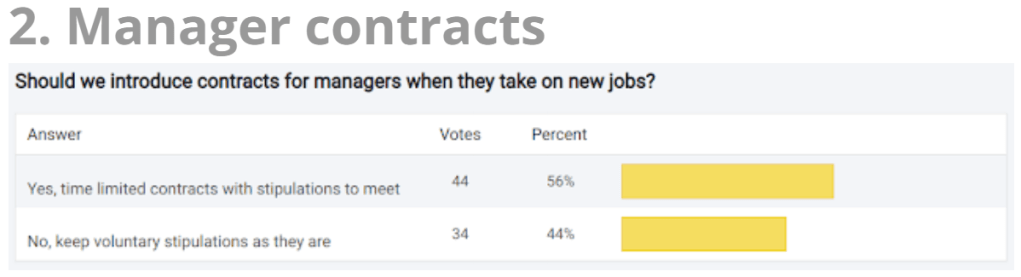
Contracts were made mandatory from D16, but were imposed without negotiation, and not published. One perception was that these new contracts were designed to force lower rated teams to sell their most sought after youth players to the teams with the highest rated players, in search of better ratings to fulfill their contract obligations and avoid the sack.
In reality, we’ve always had a mixed group of managers – some adhering (or not) to self-imposed voluntary stipulations, managers who take new clubs negotiating their own (unenforceable) contract, and others preferring neither.
What changed was the number of managers having a contract (from none to 98), and from contracts (or stipulations) being voluntary and self-imposed, to mandatory and imposed without any negotiation.
What’s clear is that we’ll never have 100 managers agreeing on something this controversial.
Contracts for those that want them?
They wouldn’t even need any input from Admin if one or more managers wanted to take on the responsibility for organising them (and they could include records of activity or anything else, if someone wanted to do that extra work), like Rahul used to with stipulations:
- Anyone who didn’t want to have a contract, wouldn’t have one.
- Everyone automatically sacked for being in the bottom three at the end of the season would continue to be reviewed as they always have been, contract or not.
- The contractors and the lifers could continue to mock each other’s efforts, or – in an alternative universe – we could all just learn to live together, tolerate (or even appreciate) our different strategies. And be kind.
At the end of the day, it’s only a game.

 Top 100
Leave a comment