


Following on from yesterday’s post about the turnover in managers in Top 100 since the SM Worlds 2.0 update, I want to address the criteria we use to select managers to replace those that leave their clubs.
Firstly, unmanaged are offered out to any interested managers already in Top 100 primarily via the newsfeed. If it’s a big job, which we think a lot of managers will be interested in applying for, we sometimes advertise in the WhatsApp and FB groups, too.
Interested managers are asked to send me a private message stating their interest. If you want to add a few lines about why you would make the best choice, that’s up to you and certainly can’t hurt your chances, especially if you haven’t won anything recently, or you’re not particularly active on the newsfeed or in the transfer market with other managers.
For example, you might be focussed on building a team for the future, so tell me what you have done to show this. It’s also worth posting occasional updates here on the blog, FB or on the newsfeed to the same effect. It helps to get your work noticed, or at least so that it doesn’t get missed.
We like to give enough time for everyone to login and see any vacancies available, especially for a big job, but there are time constraints. In-game, unmanaged clubs sooner or later start buying and selling players from and to external clubs, which is annoying and often puts clubs over the 50 player squad limit.
Usually, we put caretaker managers in to avoid this scenario, but after the SM Worlds 2.0 update this wasn’t a practical option due to the login/logout problems, and the number of managers quitting in a relatively short space of time.
However, I personally feel strongly that Top 100 is such a competitive and active game world that the better and bigger clubs need managers who login most days, and who make a point to read the newsfeed to keep up to date with what’s happening in the game world, and who check and respond to messages in a timely and helpful manner.
It’s a bit of self-selection – the managers most likely to be a good appointment to a better job will be active enough to see jobs advertised even if it’s only for a day.
I also try to make a point of asking managers who have previously applied for other clubs unsuccessfully if they are interested in any new vacancies, and sometimes message managers who I think would be a good fit for a move, although I have to say this very rarely results in any interest.
The reality is that most managers who quit Top 100 leave clubs who no one else in Top 100 is interested in managing.
Of the eleven clubs vacated, just three garnered any serious interest from managers already in Top 100. Eight clubs, no one had any interest in.
In which case, they are offered to managers waiting to join Top 100. Usually this means managers in our feeder game world Top 120. Alternatively, it could be a manager we know very well (e.g., a former Top 100 manager who wants to return), or who comes highly recommended by other Top 100 managers from other game worlds.
Once we have a list of managers interested in a job, we shortlist (assuming there’s more than one applicant). It’s usually pretty obvious that there are two, three or four managers who a clearly more experienced, better qualified and more deserving of a move to a better club than others.
By more experienced, I mean number of seasons in Top 100 (this doesn’t always mean that the longer you have been in Top 100 the more likely you are to get a job, but it helps to establish a manager’s other credentials below).
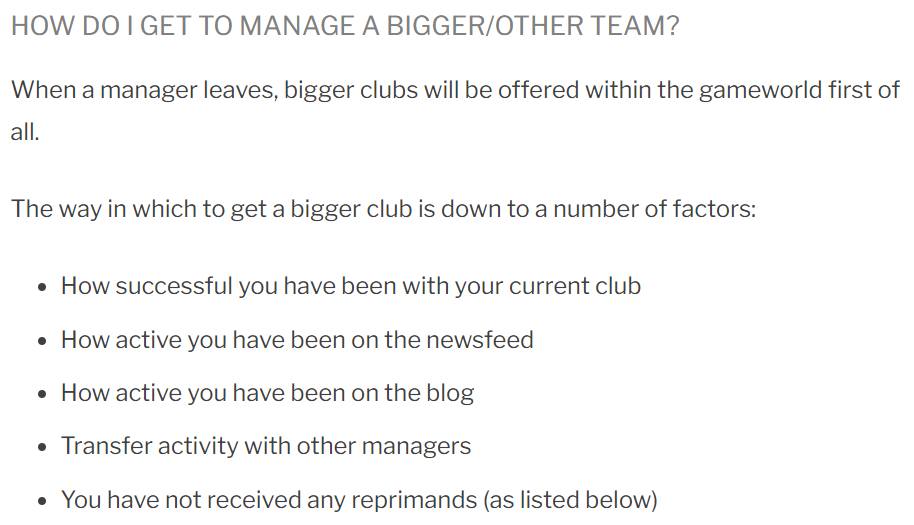
By qualified, I mean a proven track record of success on the pitch, particularly with current club (improvement in league position over seasons, promotions, trophies, youth scouting and development), and activity off it (transfer market, newsfeed, blog, WhatsApp, FB, responding to private messages, login frequency).
By deserving, I mean how long have they been at their current club? How many clubs have they had in Top 100 already? How many top clubs have they had, if any (this can be a positive or a negative)? Are they troublemakers? On a transfer ban? Regularly fail to set teams for the Youth Cup, or the League after a Youth Cup game?
Generally, we don’t shortlist managers who haven’t been at their current club for more than one full season.
All of the above is not an exact science – we don’t monitor or track managers’ activity on a spreadsheet, but we do keep a record of managers’ success, club record and in-season development.
Ultimately the final choice is a subjective one made by the admin team. It’s not always unanimous, and sometimes there can be very strong disagreements.
But the criteria above are the same criteria we have used in Top 100 since the beginning.
if you don’t believe me, head over to the old Top 100 blog.
As for recent job changes, for the sake of openness and transparency, here’s a summary of how the selection process worked:
Valencia: Two candidates. Only one manager had been at his current club for more than one full season, and was appointed.
Manchester United: Two candidates. One had already had several clubs, including big clubs, in Top 100. Although a strong candidate, we felt the other manager was clearly stronger all round and a better fit for United at this time, and that’s who we appointed.
Stoke City: Eight candidates. Four shortlisted. Non-shortlisted managers had been at their current clubs for fewer seasons and/or been less successful. Of the four shortlisted, three had had several clubs in Top 100 previously. All three are very strong managers, but we appointed the manager who had the most success with his current club (two divisional titles), whose club was currently in the best position in the league, and who we felt was most deserving (only two clubs in Top 100, no big clubs, and the longest time at his current club).
Updated below (forgot to add City, Schalke and Olympiacos jobs):
Manchester City: Similar to Stoke, six applicants, four shortlisted, appointed manager who had achieved most at his current club, been there longest and not had other clubs.
Schalke: Three candidates, one then non-Gold, one not at his current club for more than one full season.
Olympiacos: One applicant who had been at his current club for several seasons.
I think that’s a reasonably realistic way to do things, and it’s the way we’ve always tried to do it in Top 100.

 Top 100
Leave a comment